AI answers in seconds. You don’t have to.
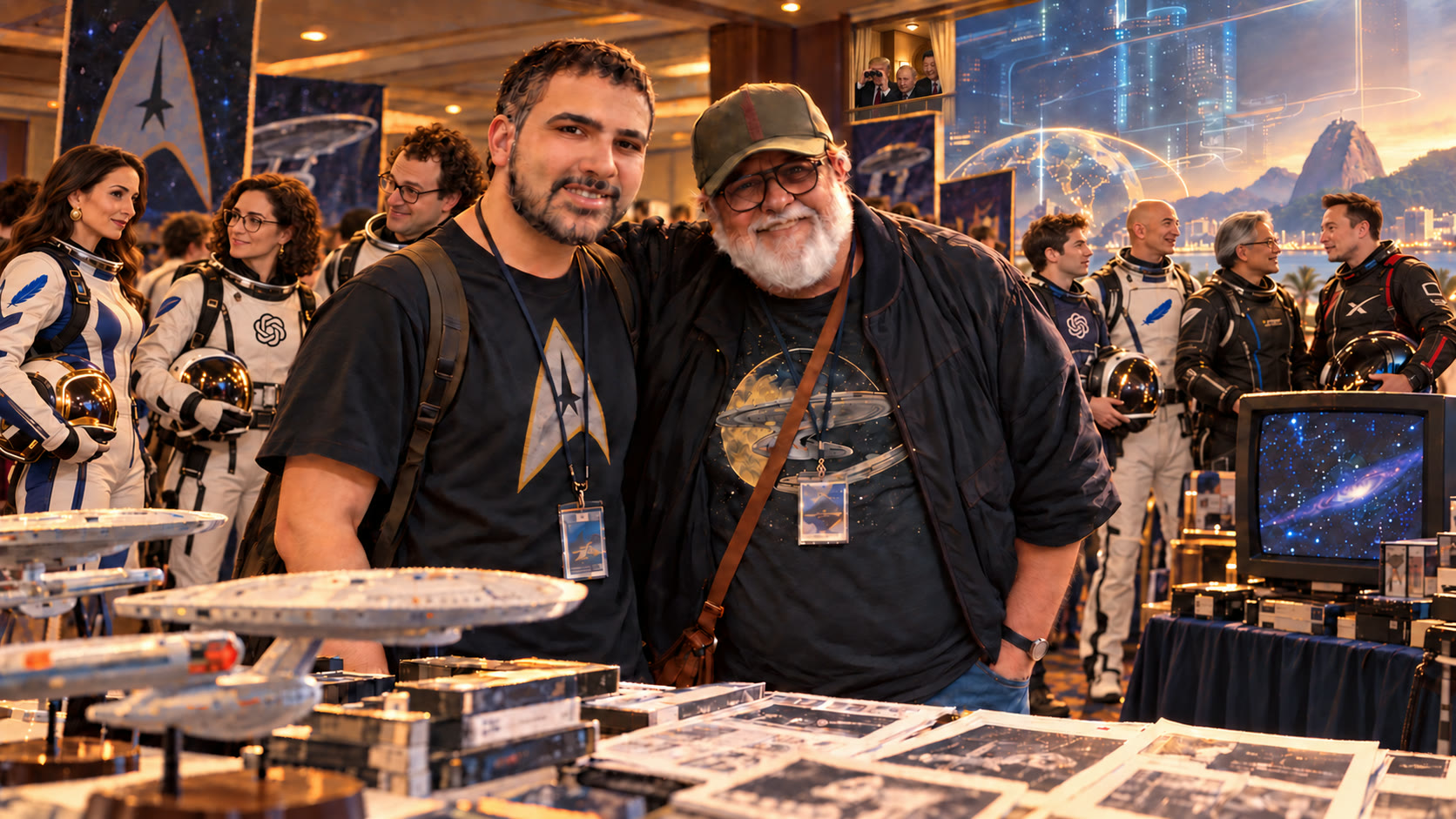
AI-generated cover: my father and I at an imagined science-fiction fan event in Rio. The scene is fictional; its role is to open the real father-and-child memory from which this chapter of my human–machine story begins.
Space, the final frontier
These are the voyages of the Starship Enterprise
Its five year mission
To explore strange new worlds
To seek out new life
And new civilizations
To boldly go where no man has gone before— Star Trek: The Original Series, opening narration (StarTrek.com).
Every Trekker knows the invitation. Before I knew what a GPU was, I was a child watching Star Trek beside my father. I learnt to imagine the future with him. Today I live inside accelerated computing, asking what machines that answer in seconds are changing in me.
This is how I am making sense of the current generative-AI moment — the era of generative models, especially the large language models (LLMs) I work with. It is not a theory about all AI, or about how everyone should live. It is what I feel while using these machines now, inside a change large enough to cross the journey of our life span too: ageing, learning and spending time that remains finite while everything around it accelerates.
I find this shift personally fascinating. Learning human–machine language in the time of LLMs, frontier models and Generative AI is a cognitive challenge of its own. Many LLMs and frontier models are built on Transformer architectures and attention mechanisms; that is not true of all Generative AI. Precisely because of that, the advance answering in seconds is teaching me not to answer at the same speed.
Language engineering with cybernetic machines
The name I found for what I am doing is language engineering with cybernetic machines.
I am not proposing a new discipline. I am trying to give a precise name to a cycle I can observe. I formulate something in language. An LLM answers. Its answer changes what I notice, what I consider important and even the question I thought I was asking. Then I formulate again.
Language → machine → changed attention → language again.
I call this recursive because the output returns as part of the next input. If nothing in me changed and I merely asked for another version, that was not recursive thinking. It was repetition with electricity.
That recursion wakes an older memory. When I studied Information Systems at PUC-Rio at night, after a demanding internship and workday, I often reached the first class exhausted; sometimes I slept through it. Algorithm analysis — dynamic programming, recursion, complexity — was the only subject I withdrew from, afraid I would fail.
I returned on a second attempt with fresher eyes, and those ideas stayed with me. Now, thinking recursively with AI, I meet them again outside an exercise sheet: an answer becomes input, the cost of each branch matters, and not every path deserves to be computed. This is nostalgia, not equivalence. A mind and an algorithm are not the same object.
The same interface also has me living between human languages. A formulation begins in Portuguese, finds another edge in English and returns differently — not because translation is automatic or perfect, but because language has become a workspace I can enter from both sides. For me, language engineering is both talking to the model and noticing what an idea gains and loses as it crosses a language.
The model already reaches me shaped by human feedback. Techniques such as RLHF (reinforcement learning from human feedback) adjust a model during training from human demonstrations and preferences. My everyday loop is not RLHF: correcting a prompt does not change the model’s weights. What it changes immediately is the next formulation — and the person formulating it.
In the article about my three loops, I wrote about what I took from Ethan Mollick’s Co-Intelligence: treating AI as someone working beside me made it visible that human bias could appear on both sides of the desk. That reading has now moved one step inward. The question is no longer only how I design agents that disagree. It has become how I design my own attention while talking to them.
Reading The Coming Wave, by Mustafa Suleyman with Michael Bhaskar helped me see the same change at another scale: as a technological wave, not an isolated tool. That is my interpretation of the book, not a formulation I attribute to it.
That is the part that does not fit in a prompt. The model participates in the recursion. I am the one who has to notice it.
The format of this article is part of its argument. It was strongly inspired by Leandro Karnal’s Deus, vaidade e morte: conversa de Karnal com uma IA (God, vanity and death: Karnal talks with an AI): a reflection on human–machine collaboration presented as human–machine collaboration. The experience, the thesis and the responsibility for what is here are mine. The machine helped interrogate them, check the references and find the form. It did not live any of this for me, and it is not an oracle.
The next answer is a stimulus too
Sometimes I notice the cycle before I can name it. I ask AI one question. The answer arrives in seconds. One sentence opens a hypothesis; the hypothesis asks for a test; the test opens another window. When I notice, I am no longer answering a question. I am being led by the promise of the next answer.
That is why I use the word dopamine carefully: as precision, not as the protagonist of the story. The classic research on reward-prediction error connects dopamine signals to the difference between expected and observed reward during learning. An experiment in humans linked dopaminergic modulation of those errors to how outcomes update future decisions. This helps me name why an unexpected result may pull attention. It does not diagnose every encounter with AI.
Reward learning is an important biological capacity, but that does not make a brain and an algorithm the same object. Biological reward learning, algorithmic reinforcement learning and RLHF touch at feedback changing what comes next. They do not collapse into one.
What I can claim is smaller and personal. I recognise novelty seeking, reward anticipation, curiosity, social validation, vigilance and urgency to respond intensifying together. The real time-management problem is not my calendar. It is the second between one answer and the next question: enough time to notice my breath, my posture, excitement, irritation and fatigue before the cycle turns them into another prompt.
To inhabit the interval is to become present enough to notice more of the experience, not less. The loop may be teaching me. It may also just be keeping me inside it.
Presence does not reduce the experience. It increases how much of it I can feel.
Making time wait
When I say I want to react like a Stoic, I am not trying to become impassive. “Live the emotions; do not run from them” is an important boundary for me.
The pause does not remove the emotion; it keeps emotion and reaction from becoming the same event.
In the Enchiridion, Epictetus returns more than once to the same move: first an impression appears; then comes the possibility of examining it. In chapter 20, he says that gaining time and respite makes it easier not to be carried away by the appearance. In 34, faced with a promised pleasure, he asks that the thing wait for a while.
An old technology for a problem with a new interface.
When an LLM answer arrives and seems to solve everything, I can let it wait. When it irritates me, I can live the irritation without immediately returning it to the machine as a new command. When it excites me, I can feel the excitement in full before turning it into five more tasks.
When in doubt, never doubt the Greeks. They know things.
What interests me in that irony is quite serious.
Making time stop is not stopping the world. It is separating impression, emotion and choice for long enough that the choice becomes mine again.
The body needs to recognise the environment
I have also started treating the places where I work as part of this language.
I am learning AI in front of more screens than I can look at at once.
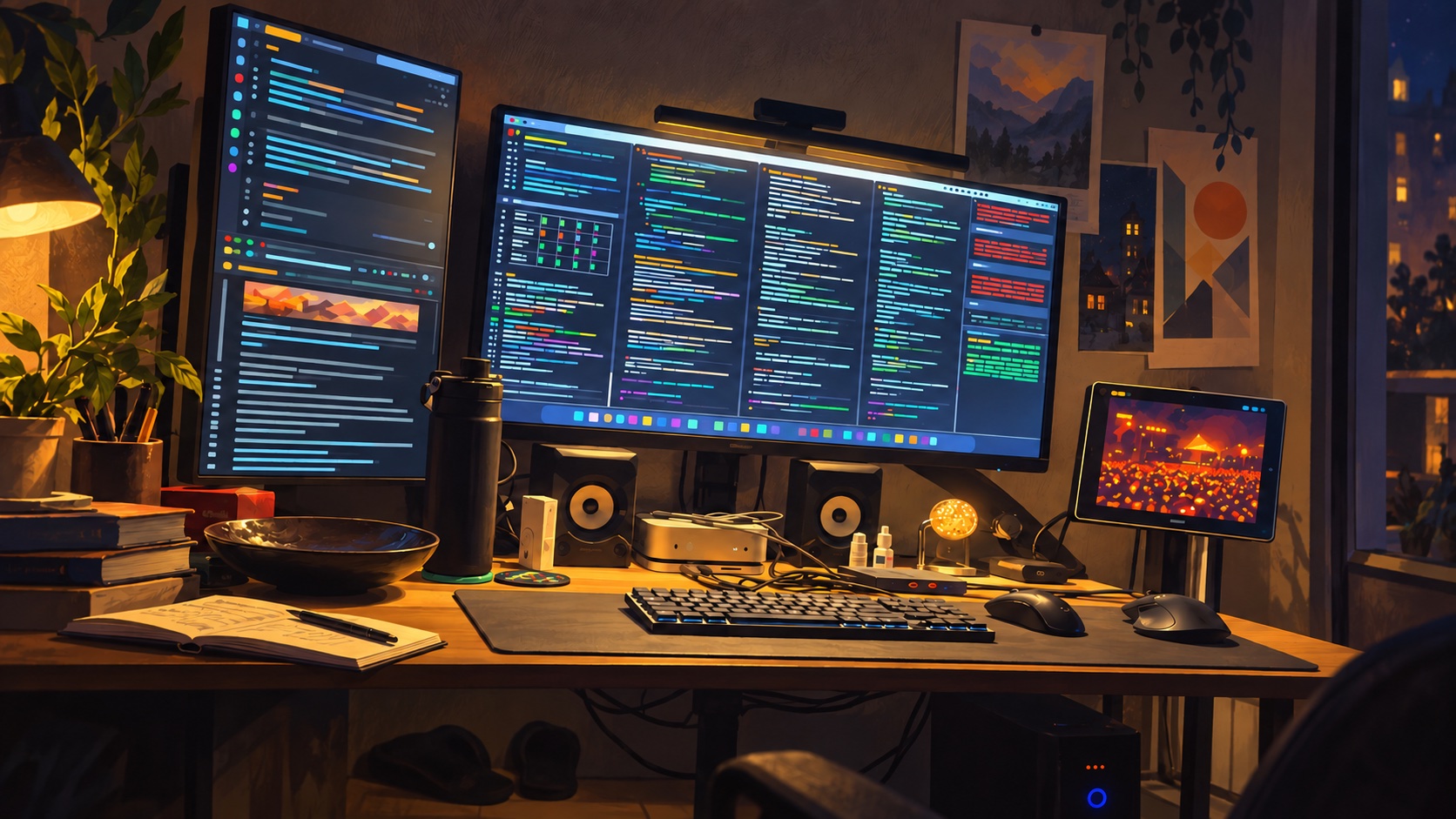
AI-generated argument bridge based on a photograph of my real workspace. The physical arrangement comes from that environment; the screen content was abstracted to protect private context. It expresses the sensory density of learning across more screens than I can attend to at once.
Is this RLHF — reinforcement learning from human feedback? Not exactly. This is being human.
It is not an exceptional scene. The repetition is precisely the point: an answer appears, opens three paths, moves my attention and makes asking for the next one very easy. Words come back faster than my body can notice what happened to them.
I move through different contexts on the same screens, sometimes within the same hour. When all of them have the same physical arrangement, the passage becomes invisible. The work changes; the body keeps receiving the same frame.
Visually distinct arrangements help me mark the transition. I change the position of screens, objects, what stays open and what leaves my field of view. I am not claiming that this architecture improves cognition for everyone. For me, it gives a physical shape to a change that used to exist only inside my head.
Today’s discovery is that I need the same distinction in the harness. I cross personal projects, internal environments, client contexts and different harnesses; the ethical principles that protect my individual responsibility need to cross those boundaries with me. The principles that protect your responsibility need to travel with you; the local context only says where you are.
My personal baseline carries the ethical principles I cannot delegate. Privacy by harness perimeter is one of them. Each workspace anchors the role — personal, internal or client — and adds its local constraints. Governed employer or client policy stays inside that perimeter; it does not travel back into my personal baseline. What travels is the principle. Identity and another sphere’s property do not.
It makes the experience more sensory, not less. The environment stops being a background and becomes a signal. The screen stays on, but I can recognise which work it is calling me into — and, sometimes, recognise that I do not want to answer yet.
This is a journey in intense contact with myself. From the outside, the signals are subtle: an object changing place, a window closing, one minute before the next question. Inside, the succession of screens, answers and environments crosses the whole body.
The intelligence I want to own
Garry Tan called his latest keynote Own Your Intelligence. Y Combinator’s own description presents agents running on infrastructure you control, compounding knowledge over time, and the difference between owning that intelligence and renting it.
In the previous article, I had connected another talk of his to a company’s brain: models are rented; what an organisation learns can be its own. This new keynote pushes the question toward the person.
Last night, I was reading Yuval Noah Harari’s Nexus. The book crosses history through information networks and flows. What stayed with me is my interpretation, not a quotation from Harari: perhaps AI is becoming a new lever of the age of knowledge and information — and I am trying to learn how to touch it without handing it all of my time.
I have lived that scale arriving in layers. The internet connected networks; hypertext gave documents relationships before HTTP offered a practical way to move them across the Web. Broadband changed the tempo, mobile changed where access happened, cloud changed how computing could be provisioned, and GPUs expanded what we could run in parallel. They are not one invention, or a neat causal chain. In my life, they form a succession of interfaces and scale — and generative AI is the latest layer to become ordinary while I am still learning what the earlier ones did to me.
That lever has a strange and beautiful material genealogy. NVIDIA’s own published history begins with 3D graphics for gaming and multimedia; in 2006, CUDA opened the parallel-processing capability of GPUs to general-purpose computing. During the pandemic, crypto amplified demand for that hardware without creating the technology: in its 2022 annual filing, the company attributed Gaming growth to a combination that included games, remote work and mining, and reported $550 million in dedicated mining-processor revenue. Demand is not technical origin. It was another wave pushing the same substrate.
Before I knew what a GPU was, I was a millennial child who watched Star Trek intently with my father. Today, accelerated computing, machines I can talk with, spaceflight and interplanetary ambition make me feel that I am living in a real Star Trek era. Blue Origin flew William Shatner to space; SpaceX states that it wants to make life multiplanetary. For the child I was, this explains the affection: the founders are surrounding cultural signals, not heroes.
And here is the punch that tied the image together for me: I live in the era of aligned human–machine language programming, powered by electrical energy and running on parallel computing whose commercial lineage was developed, in essence, through graphics and video games. “The NVIDIA era” is my historical shorthand, not a claim that one company invented parallel computing by itself, or that every LLM depends on one supplier. Programming through human language does not eliminate code either: it means formulation, context and correction now direct a real part of the work.
Jensen Huang calls this shift accelerated computing: in 2024, he said it had reached a tipping point; in 2026, NVIDIA described AI as essential infrastructure powering a new industrial era. That is the company’s account of the moment, not a neutral history of it. In the wider history, Huang is one of its principal material architects. In my personal reading, he is the architect of this moment.
This is what I mean by the “NVIDIA present”: the infrastructure that learnt to draw worlds now participates in the linguistic machines with which I rearrange mine. For me, that is one of the central images of the current generative-AI moment.
This is where another figure from Star Trek returns to me: Data. The character’s official history shows an android turning to painting, music, poetry and theatre to investigate a humanity he could observe but not experience as we do.
Am I Data today? The question arrives reversed. Data was a machine using art, relationships and experience to understand what it meant to be human. I am a human using machines, language and art to understand my own humanity.
Agent Harness Engineering, prompt engineering, tokenmaxxing, language engineering: these names are attempts to touch parts of the practice I am living, not to turn it into a new doctrine. Underneath them, what I recognise is a personal ontology of the human–machine relationship — body, attention, language, time, memory, environment, feedback, work, childhood and future. The harness invents none of those things. It makes them observable and versioned while I build, so I can return and recognise not only what I made, but who I was becoming as I made it.
The extension is mine, not his: owning my intelligence begins before the infrastructure. It begins in the conditions under which I allow it to change. The memory I keep matters. The procedures I write matter. So do the pace at which I ask for the next answer, the environment where I read it, and the interval I preserve before reacting.
This is what the present chapter of my professional life is asking me to learn. I offer it as a gift, not as a method: a pause you might be able to try in your own context.
Two experiments to take with you: before your next prompt, name what the last answer changed in your attention; and give two work contexts one visible physical difference, just to see whether the passage between them stops being invisible.
This is not a productivity system or a promise against burnout. “Without burnout” is the boundary I want for my own life, not a clinical outcome I can guarantee. What I can practise is smaller: live the emotions without running from them, recognise what was possible today, and believe I did my best up to that limit.
One day at a time. Stoically, if possible. Human either way.
This is a personal, independent effort that I sustain myself. My commitment is to keep learning in public with the people and machines of this era, and give back what I discover for as long as I can sustain the tools and infrastructure that make this work possible. I want to receive what this extraordinary era offers without disappearing from the present in which it arrives.
This is what is happening today, at scale. I don’t know if you’ve noticed it. Tell me what you think.
A hug, and see you next time.
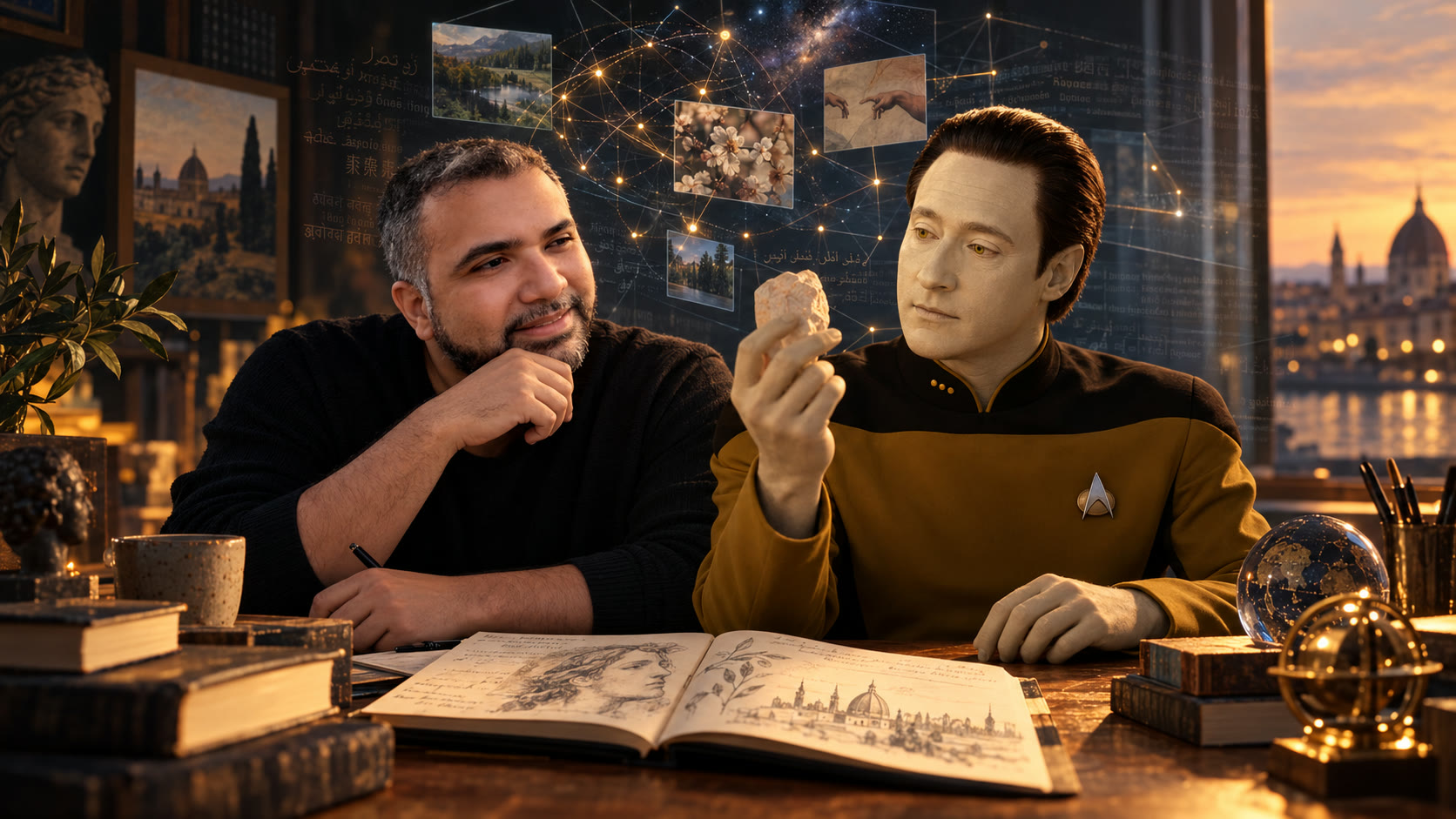
AI-generated reflective footer: Data is the inverse mirror. The android used art and relationships to investigate humanity; I use machines, language and art to observe my own. The image returns this chapter's live question without answering it for me.
“Is this AGI — or does it only seem that way? Time will tell.”
THIS IS WHAT I THOUGHT · tadeumendonca.io